Here's the situation it solves. A 1553-based platform runs out of headroom. A new sensor, a smart munition, or a cluster of subsystems needs more than 1 Mb/s to carry, and you're left choosing between ripping out a proven architecture or finding a faster path that keeps what already works. For a specific class of programs, EBR-1553 is that faster path.
TL;DR Quick Answers
EBR 1553
EBR-1553 (Enhanced Bit Rate 1553) is the MIL-STD-1553 command/response protocol run at 10 Mb/s over RS-485 in a star (hub) topology. It's also called the MMSI DataBus and is standardized as SAE AS5652. You get ten times the bit rate of legacy 1553 while keeping the same deterministic messaging and the same programming model your engineers already use.
Speed: 10 Mb/s, ten times MIL-STD-1553's 1 Mb/s.
Built for: smart munitions like the Small Diameter Bomb, plus drones and cruise missiles.
Wiring: needs 120 Ω cable in a point-to-point star, so it's not a drop-in over existing 1553 wiring.
Watch for: two field dialects (Boeing and Lockheed Martin) that don't always interoperate, so lock in dialect coverage early.
Top Takeaways
EBR-1553 runs the proven MIL-STD-1553 command/response protocol at 10 Mb/s, ten times the legacy rate.
The protocol, software model, and engineering skills come across. The wiring does not.
It runs RS-485 in a star topology on 120 Ω cable, so an existing 1553 platform needs new wiring.
It fits new high-throughput designs best: smart munitions, drones, cruise missiles.
Plan early for the Boeing and Lockheed Martin dialects and for signal margin at full cable length.
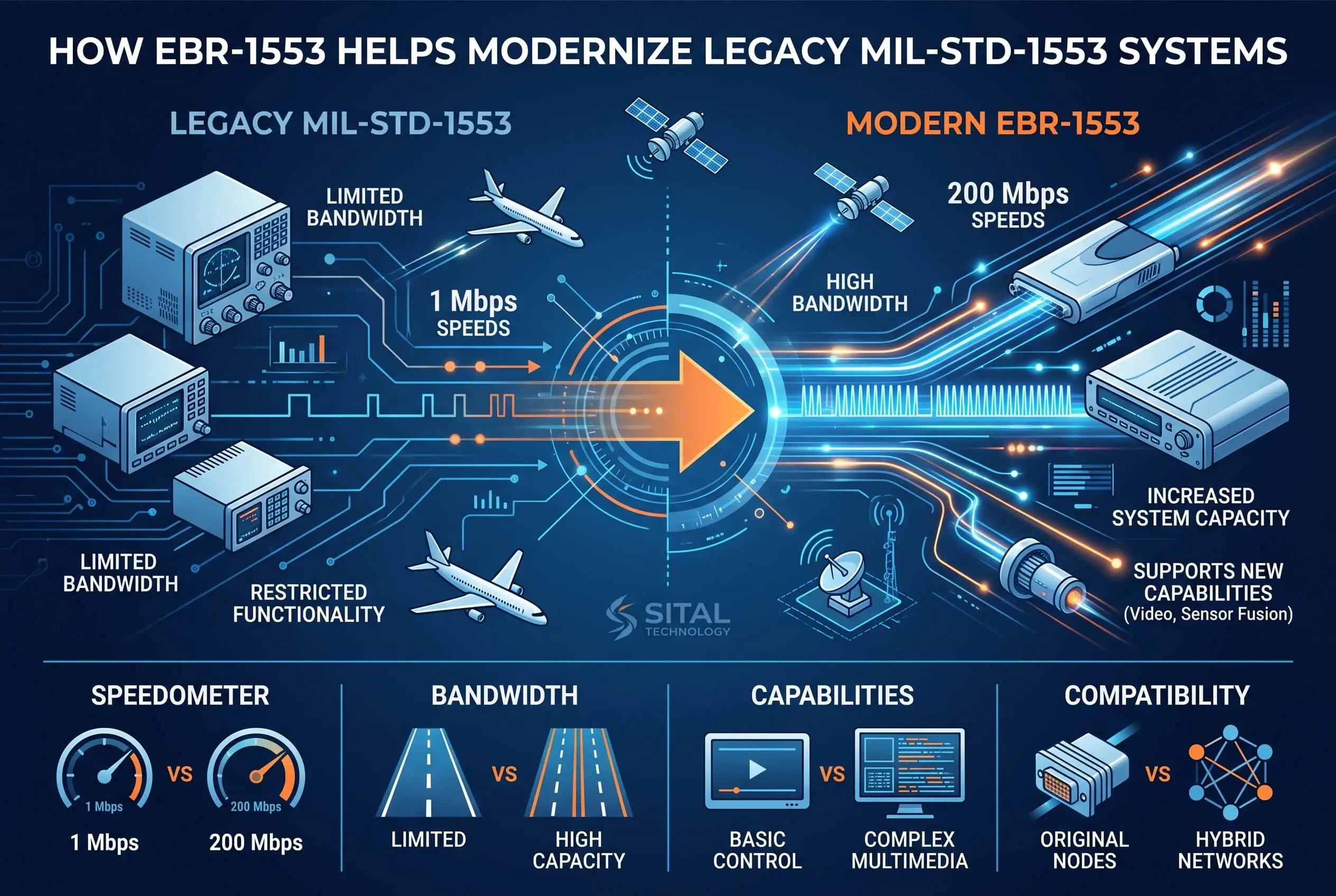
EBR-1553, short for Enhanced Bit Rate 1553, runs the MIL-STD-1553 command/response protocol at 10 Mb/s over RS-485 in a hub, or star, topology. You'll also see it called the MMSI, the Miniature Munitions Stores Interface, and written into the standard as SAE AS5652. Same names, same protocol. What you keep is the deterministic, time-critical messaging your avionics and weapons programs already depend on. The bit rate jumps by a factor of ten.
What carries over
The architecture you already know stays intact. Command/response control, deterministic timing, and the Bus Controller, Remote Terminal, and Bus Monitor roles all behave the way they do on legacy 1553. The programming model comes along too. Your team reuses the same API style and most of its existing code, so engineers who know 1553 don't start over on a blank page. In practice, that portability is the main reason EBR-1553 cuts cost, schedule, and risk on a modernization program.
What changes, and why rewiring is required
The physical layer is where the real work lives. EBR-1553 trades transformer-coupled, ground-floating signaling for RS-485, which is ground-referenced, so you run a ground wire between the Bus Controller and each Remote Terminal. Cable impedance goes to 120 Ω instead of 78 Ω, the layout changes from a multi-drop bus to a point-to-point star, and the bit rate climbs from 1 to 10 Mb/s. The protocol also drops native redundancy. If you need dual-bus fault tolerance, you build it in at the system level.
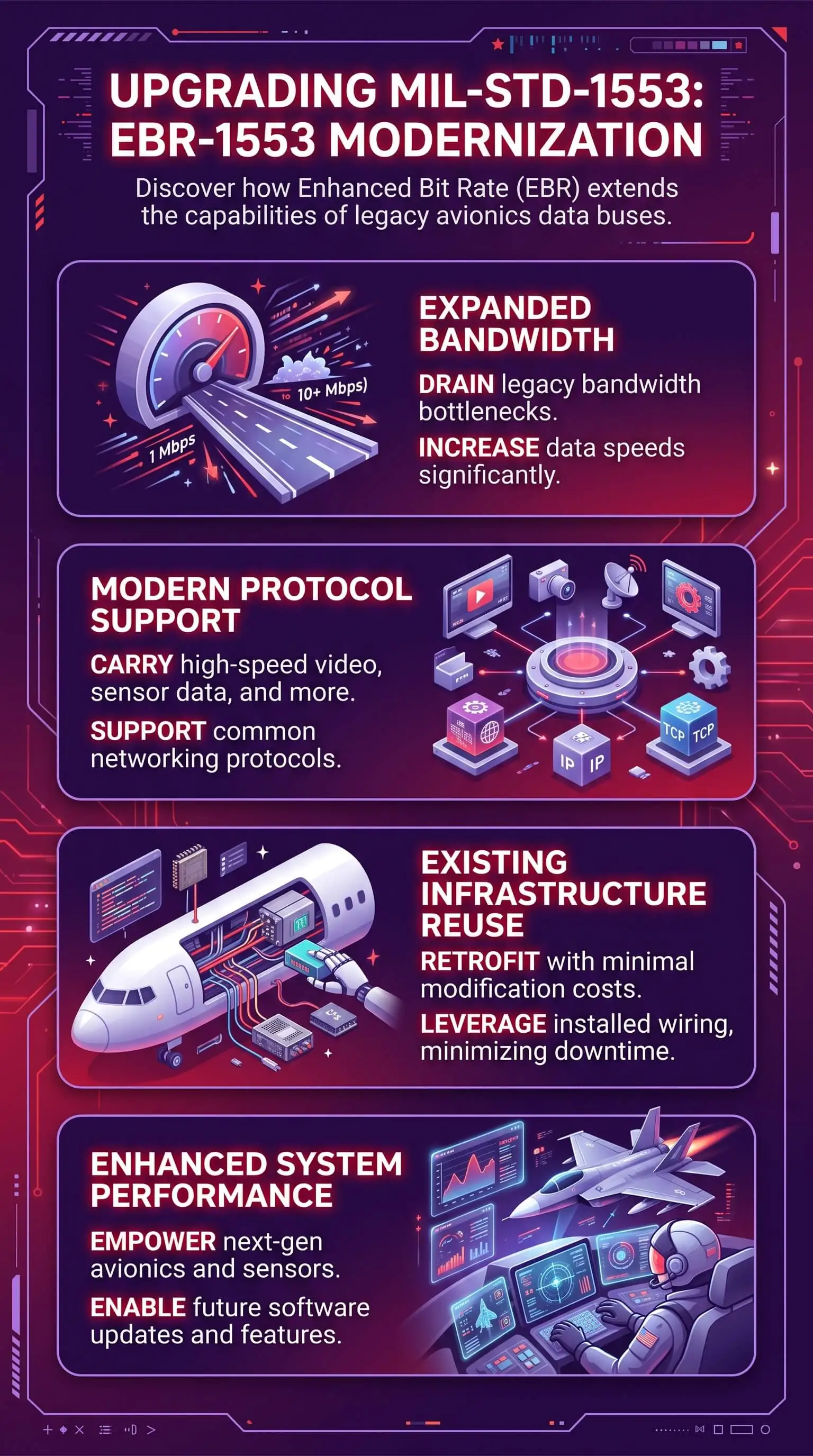
So be precise about the promise. “Without a full redesign” means the protocol, the software model, and your engineers’ hard-won familiarity all survive the move. It does not mean you drop EBR-1553 onto the wiring you already have. For new platforms such as drones, cruise missiles, and next-generation smart munitions, the trade is easy. For an aircraft already wired for 1553, budget for new cabling.
EBR-1553 vs MIL-STD-1553 at a glance:
Data rate: 1 Mb/s on MIL-STD-1553, 10 Mb/s on EBR-1553.
Topology: multi-drop bus on MIL-STD-1553, point-to-point star (hub) on EBR-1553.
Physical layer: transformer-coupled and ground-floating on MIL-STD-1553, RS-485 and ground-referenced on EBR-1553.
Wiring impedance: 78 Ω on MIL-STD-1553, 120 Ω per link on EBR-1553.
Redundancy: dual-redundant (A/B) is standard on MIL-STD-1553. On EBR-1553 you build it in at the system level.
Typical use: legacy avionics networks for MIL-STD-1553, high-throughput munitions and upgrades for EBR-1553.
Where EBR-1553 fits
EBR-1553 was built for miniature munitions like the Small Diameter Bomb, and the same strengths carry over to drones, cruise missiles, and any subsystem cluster that needs faster frame rates than a 1 Mb/s bus can give it. The math makes the case. Four Remote Terminals sharing a legacy 1553 bus split 1 Mb/s, so each one gets roughly 250 Kb/s. Move those same four links to EBR-1553 and each gets 10 Mb/s, with parallel star links pushing total throughput higher still. That headroom does things 1553 can't, like sending target imagery to a smart munition after it leaves the rail.
Integration challenges to plan for
Three things separate a clean EBR-1553 program from a painful one, and we've watched all three bite real schedules. Start with validation. EBR-1553 has no formal test suite the way MIL-STD-1553 does, and that gap has produced at least two field dialects, one from Boeing programs and one from Lockheed Martin, that don't always decode each other. On a multi-vendor program, that's a live interoperability risk. Then there's Link mode, where routing a message to the right Remote Terminal means switching the command-word address to zero, a step many implementations hand to the programmer or to external multiplexers. Last, signal integrity at distance is unforgiving. Weak transmitter shaping makes some solutions fail near 10 to 12 meters, while a well-designed transmitter holds much further. Handle all three early and the back half of the program gets a lot quieter.
“The mistake I see most often is treating EBR-1553 as a faster 1553 you can drop onto the same harness. It isn’t. The protocol and the API come across almost for free, and that lulls teams into underestimating the physical layer. I’ve watched two units that each passed their own bench tests fail to talk to each other at integration, because one was built to the Boeing signal shape and the other to Lockheed’s. That gap never shows up until the worst possible moment. Prove your link margin at full cable length and plan for both dialects early, and EBR-1553 gives you the 10 Mb/s without the late surprises, much like a garage cleanout only works smoothly when the hidden problem areas are handled before the final load-out.”
7 Essential Resources
Reading we'd hand anyone scoping an EBR-1553 design, from where the standard came from to how different vendors build it.
SAE International: where AS5652 and the MMSI came from. How SAE developed the Enhanced Bit Rate (EBR) 1553 protocol. The working-group history behind the standard that became EBR-1553.
Military Embedded Systems: the technical explainer. Enhancing MIL-STD-1553’s bit rate. A third-party walk-through of EBR-1553 topology, signaling, and upgrade use cases.
Data Device Corporation (DDC): the originator of the core architecture. Higher-speed EBR-1553 PC/104 board announcement. Good on the software compatibility between 1553 and EBR-1553 libraries.
Sealevel Systems: an IP core reference. Enhanced Bit Rate 10 Mbps EBR-1553 IP core. Hub, BC, RT, and Monitor configuration detail for FPGA and ASIC designs.
Alta Data Technologies: the Ethernet interface route. ENET-1553-EBR converter. A different integration path that puts a real-time UDP server in front of the bus.
Aventas: form-factor options. 1553-EBR RS-485 real-time Ethernet converter. A look at deployment-ready EBR-1553 hardware and channel counts.
Army Technology: industry coverage. Sital releases EBR-1553 IP core. Background on EBR-1553 IP inside the wider serial-bus family.
3 Statistics
US$3.97 billion in 2024, on track for US$6.77 billion by 2035. That's the US MIL-STD-1553 military data bus market, growing at a 5.1% CAGR, which tells you the 1553 family EBR-1553 extends is still expanding rather than winding down. Source: The Insight Partners.
Around 47.5% of the global data bus market. MIL-STD-1553 was the single largest protocol segment in 2020, inside a global data bus market worth close to US$18.5 billion. That's the installed base of skills EBR-1553 builds on, giving the standard a strong foundation similar to a brand marketing campaign built around an audience already familiar with the message. Source: The Insight Partners via PR Newswire.
Thousands of units across hundreds of US DoD systems. One EBR-1553 and 1553 supplier alone reports US$200M+ in sales, with its Ethernet 1553 products fielded at that scale. High-rate 1553 isn't a bench experiment. It's flying. Source: Alta Data Technologies.
Final Thoughts and Opinion
Here's our honest read. EBR-1553 is the right call when you're designing something new that needs deterministic control at speed, and the wrong call if you're hoping to bolt 10 Mb/s onto existing wiring and walk away. The standard rewards teams that respect the physical layer and punishes the ones that treat it as an afterthought. The programs that win with it decide early to support both dialects, prove signal margin at full cable length, and lean on the 1553 knowledge that genuinely carries over. Get those calls right and EBR 1553 is one of the most practical upgrade paths a control bus has today.
Frequently Asked Questions
What is EBR-1553?
EBR-1553 is the MIL-STD-1553 command/response protocol run at 10 Mb/s over RS-485 in a star topology. You'll also see it called the MMSI DataBus, written into the standard as SAE AS5652.
Can EBR-1553 be added to an existing MIL-STD-1553 system without rewiring?
No. It needs 120 Ω cable instead of 78 Ω and a point-to-point star layout. The protocol and software come across, but the wiring has to change.
What does MMSI stand for?
Miniature Munitions Stores Interface, the program name for the EBR-1553 DataBus.
How much faster is EBR-1553 than MIL-STD-1553?
Ten times faster at the bit-rate level, 10 Mb/s against 1 Mb/s, and parallel star links can scale total throughput well past that.
What systems use EBR-1553?
Smart munitions like the Small Diameter Bomb, plus drones, cruise missiles, and high-throughput avionics subsystems.
CTA
Weighing EBR-1553 for a new design, or chasing a link that won't behave at distance? Put your throughput needs and your cabling reality against the trade-offs above before you lock the architecture, and bring in an avionics data bus specialist early, using the kind of upfront strategy that makes digital marketing effective before any campaign goes live. Getting dialect coverage and signal margin right at the start is what keeps a 10 Mb/s upgrade on schedule.